
Restoration that begins with understanding why.
Hair loss in women is often quieter than in men, a widening part, less volume, more scalp showing through, and its causes are just as varied. At OLA Hair, restoration begins by understanding why your hair is thinning, so the right treatment follows. For some women that means a tailored non-surgical plan; for others, follicular unit extraction (FUE) to restore density where it's needed. Every path is guided by our registered doctors, planned privately in our West Perth clinic, with the same integrity and discretion that defines everything we do.
A Note from Dr Indi
Hair loss in women is often lived with quietly. It can affect your confidence in a way that's hard to explain to others, and too often it's brushed aside rather than properly looked into. I don't believe in that approach.
You'll always be met with honesty first. Before we talk about any treatment, we work to understand why your hair is thinning because the right answer depends entirely on the cause. Sometimes that's a non-surgical plan, sometimes a transplant, and sometimes simply addressing something treatable. Whatever it is, you'll be told plainly, and we'll only recommend what genuinely helps.
More than anything, I want you to feel the same comfort and trust that OLA was built on. I look forward to welcoming you.
Summary
- Approach: Diagnosis first, then a tailored plan, non-surgical, surgical (FUE), or a combination
- Surgical technique: Follicular unit extraction (FUE), where suitable
- Non-surgical options: May include PRP, mesotherapy or prescribed medical therapy
- Anaesthetic (for FUE): Local anaesthetic
- Downtime: Minimal for FUE; most people return to everyday activities within a few days
- First signs of growth: From around 3–4 months (for a transplant)
- Full results: Around 6–12 months (for a transplant); non-surgical results build gradually
- Longevity: Long-lasting, depending on the treatment and cause
- Suitable for: Women with thinning, a widening part, traction loss, or hair loss with an identifiable, treatable cause
- Performed by: OLA's registered doctorsFirst step: A private consultation to identify the cause and confirm the right treatment
Treatment Areas
- A widening part -— restoring density along a part line that has opened up
- Crown & top of scalp - the areas where female thinning most often shows
- Temples & hairline - addressing recession or thinning at the front
- Traction-affected edges - restoring hair lost along the hairline from tight styles or extensions
- Diffuse thinning - building overall density where hair has thinned evenly
- Scar camouflage - reintroducing growth over scars, where suitable
Why women's hair loss needs a different approach
Female hair loss rarely looks like male hair loss. It usually shows as diffuse thinning a wider part, less density through the top, more scalp visible rather than a receding hairline or bald patches, and the frontal hairline is often preserved. Treating it well starts with recognising that difference.
The causes are broad, too: genetics, hormonal changes such as after pregnancy or through menopause, PCOS, thyroid function, low iron, stress, and traction from tight styles or extensions. Many of these are treatable, and some reversible, without surgery, which is exactly why the cause has to be found before any treatment is chosen.
It also shapes whether a transplant is the right answer. Because thinning can be diffuse, your donor area is assessed carefully, and a transplant is only recommended when your donor hair can properly support the result. Sometimes a non-surgical plan is the better path and if it is, we'll tell you.
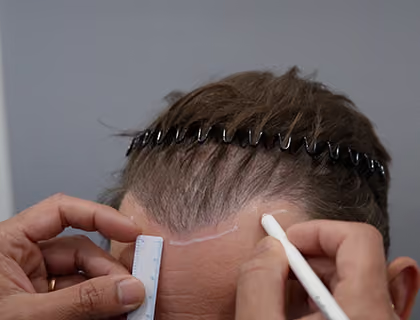
Your restoration, step by step
From your first conversation to your final result, every stage is handled by our medical team with care, clarity and discretion.
Consultation & diagnosis
Your journey begins with a private consultation with an OLA doctor. We assess your scalp, hair and the pattern of your thinning, and look into the underlying cause including where relevant, factors such as hormones, iron or thyroid so your treatment addresses the reason, not just the symptom.
A plan tailored to you
Based on the cause and your goals, we design your plan. That may be a non-surgical approach such as PRP, mesotherapy or prescribed medical therapy, a hair transplant, or a combination always matched to what will actually work for you.
Treatment
If a transplant is right, the area is comfortably numbed with local anaesthetic and individual follicles are extracted from your donor area using FUE, then placed to restore natural density and direction. Where a non-surgical plan is right, we guide you through each step.
Aftercare & follow-up
You'll receive clear, tailored aftercare guidance, and we stay in contact through your follow-ups to track your progress as it develops over the months that follow.
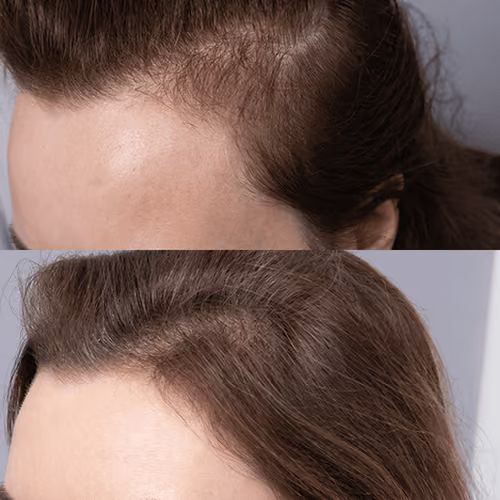
Is hair restoration right for you?
The right treatment and whether a transplant is even the best option depends on the cause of your hair loss and the quality of your donor area. Women with stable, well-defined thinning and a healthy donor zone can be good transplant candidates; where thinning is very diffuse or the donor is affected, a non-surgical plan is often the better path.
Suitability is a medical decision, not a checkbox. The only way to know what's right for you is a proper assessment, and we'll always recommend what genuinely helps, whether that involves surgery or not.
Not sure where you sit? A consultation is the clearest first step.
Results, and the timeline behind them
If you have a transplant, the transplanted hair sheds within the first few weeks expected, and not a setback. Before new growth begins from around 3–4 months and matures over roughly 6 to 12 months. Non-surgical treatments work more gradually, with improvement building over months of consistent care.
Individual results vary. Your doctor will discuss what you can reasonably expect based on your own hair, the cause of your thinning and your goals during your consultation.

Frequently Asked Questions
Request Your Private
Consultation at OLA Aesthetics
OLA Aesthetics is a doctor-led clinic in a heritage building in West Perth, home to experienced registered practitioners and a small, deliberately curated team. Hair restoration sits within a wider philosophy of skin and appearance medicine, which means your treatment is considered in the context of your whole picture, not sold as a one-size procedure.Integrity and discretion guide every consultation.
We prioritise honest, transparent conversation over pressure, and we'll only recommend a transplant when it's genuinely the right option for you.
AHPRA-registered practitioners · Australian College of Aesthetic Medicine · RACGP · CPCA


